












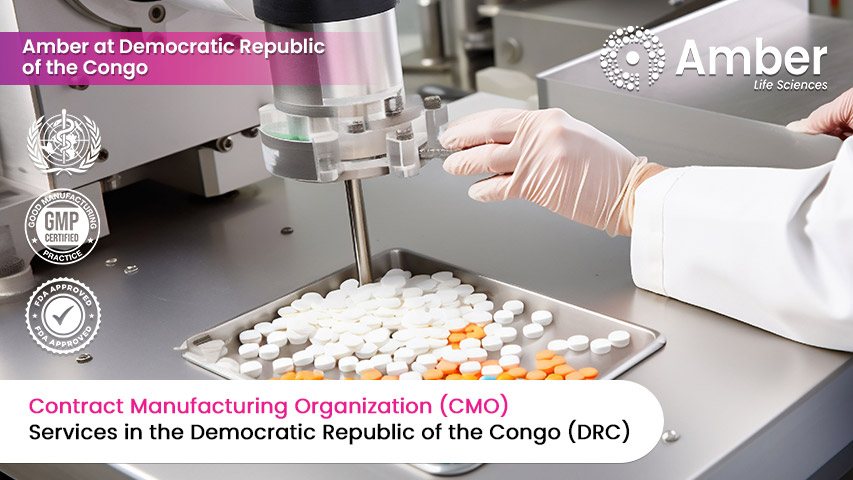
The pharmaceutical market in the Democratic Republic of the Congo (DRC) relies heavily on Contract Manufacturing Organizations (CMOs), as it is expanding with a population of over 100 million and significant unmet healthcare needs. However, local pharmaceutical manufacturing remains underdeveloped, with most medicines imported from India, China, France, and regional African suppliers.
This makes Contract Manufacturing Organization (CMO) partnerships an essential strategy for ensuring reliable, cost-effective, and compliant medicine supply. While full-scale CMOs are rare in the DRC, opportunities exist for hybrid partnerships with international CMOs and local distributors.
Current Pharmaceutical Landscape in the DRC
- Import Reliance: 90–95% of medicines are imported, primarily from India, China, Belgium, France, and South Africa.
- Local Manufacturing Limits: Only a few companies, such as Phakima, Pharmagros, and Sipharma, operate small-scale facilities focused on:
- Secondary packaging
- Repackaging bulk imports
- Producing simple generics (paracetamol, ORS, syrups)
- Regulation: The Ministry of Health, through the Direction de la Pharmacie et du Médicament, oversees registration and compliance. Enforcement is still maturing to align with WHO-GMP standards.
What CMO Services Look Like in the DRC Today
- Local CMOs (Basic Operations)
- Services: secondary packaging, basic tablets, syrups, French labeling.
- Limitations: low GMP compliance and limited scalability.
- International CMOs with Local Hubs
- Indian and European manufacturers set up packaging and logistics bases in the DRC.
- Helps meet “local content” policies and reduces import delays.
- Hybrid Model (Most Viable)
- Products are manufactured internationally (India, Europe, South Africa).
- A local Congolese distributor manages regulatory approvals, customs, storage, and distribution.
- Final packaging or bilingual labeling is often completed locally.
Challenges of Contract Manufacturing Organizations (CMOs) in the DRC
- Infrastructure issues: unreliable electricity, weak road networks.
- Regulatory delays: lengthy medicine registration timelines.
- Logistics risks: customs clearance delays and high transportation costs.
- Workforce shortage: limited skilled pharma professionals.
- Unstable political and economic environment: recurring currency swings and complex administrative procedures.
CMO Opportunities in the DRC Pharmaceutical Market
- Authorities are promoting domestic pharmaceutical production to enhance access to healthcare.
- The African Medicines Agency (AMA) framework is improving regional harmonization.
- World Bank’s PACT program supporting African pharma capacity.
- Massive demand for affordable generics in malaria, HIV, TB, and maternal health.
- Strategic location as a central hub for Central Africa distribution.
Recommendations for Companies Seeking CMO Services in DRC
- Initial approach: Produce through a trusted international CMO (India, Europe, or South Africa) while collaborating with a reputable distributor in the DRC.
- Due diligence: Audit local partners for compliance, financial stability, and logistics capacity.
- Regulatory guidance: Engage a local expert to simplify and expedite product registration.
- Robust supply chain planning: Account for customs delays and distribution challenges.
- Long-term monitoring: Watch for government incentives and new industrial partnerships.
Why Choose Amber Lifesciences Pvt. Ltd. for CMO Services in the DRC
Amber Lifesciences Pvt. Ltd., based in India, is a leading global pharmaceutical CMO trusted across LATAM, Africa, and Asia. For companies targeting the DRC pharmaceutical market, Amber provides unmatched advantages:
- WHO-GMP & EU-GMP-certified facilities ensuring regulatory compliance.
- Cost-effective production with flexible batch sizes suited for emerging markets like the DRC.
- Experience in African markets, including logistics for hot-climate stability and Francophone labeling.
- Regulatory support: dossier preparation aligned with Ministry of Health / Direction de la Pharmacie requirements.
- Comprehensive services: formulation development, packaging, labeling, quality testing, and global distribution.
- Trusted partnerships: strong track record with African importers, distributors, and government tenders.
By choosing Amber Lifesciences, companies gain a reliable partner that bridges international manufacturing excellence with the on-ground realities of the DRC market.
Conclusion
While advanced local Contract Manufacturing Organizations‘ services are limited in the DRC, the market offers huge growth potential for international pharmaceutical companies. The hybrid model—manufacturing abroad and distributing locally—remains the best strategy today.
With its global certifications, African expertise, and regulatory know-how, Amber Lifesciences Pvt. Ltd. is the ideal partner for companies entering the Congolese pharmaceutical market.
