












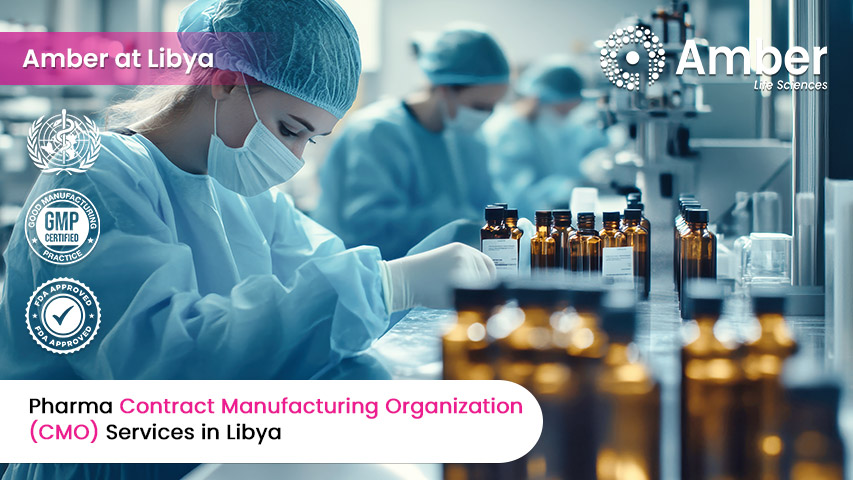
The Libyan pharmaceutical market is almost entirely dependent on imports, with over 90% of medicines sourced from abroad. While there is strong interest in building local pharmaceutical capacity, Libya’s Contract Manufacturing Organization (CMO) sector is still in its early stages and faces structural, regulatory, and economic challenges.
Currently, Libya lacks a mature, international-standard CMO sector like those in India, China, or Europe. However, Amber Lifesciences, a WHO-GMP and ISO-certified global CMO, provides comprehensive contract manufacturing services, bridging the gap by offering packaging, labeling, and full-scale pharmaceutical production for companies entering the Libyan market.
Current State of Pharmaceutical Manufacturing in Libya
- Public Sector Dominance: The National Pharmaceutical Company (NPC) controls several plants in Tripoli, Benghazi, and Zawiya.
- Private Manufacturers: Smaller private players exist, but with limited scope.
- Focus Areas: Most local manufacturing revolves around secondary packaging (blistering, bottling, Arabic labeling) and simple formulations like IV fluids and syrups.
- Limited CMO Activity: Local facilities may engage in small-scale packaging or tender-based collaborations but lack large-scale CMO infrastructure.
Key Challenges for CMO Services in Libya
- Political Instability: Ongoing conflict impacts investment and long-term operations.
- Economic Volatility: Limited forex availability and banking restrictions affect imports of APIs and equipment.
- Regulatory Gaps: Inconsistent application of international GMP standards limits quality certification.
- Infrastructure Deficits: Unreliable electricity and logistics challenges impact supply chains.
- Skill Shortages: Lack of trained personnel in QA, QC, and GMP compliance.
- Supply Chain Disruptions: Slow and costly imports of APIs and packaging materials.
CMO Potential Partners for Contractual Work
- National Pharmaceutical Company (NPC): Primary entity for government-backed contract projects.
- Libya Pharmaceutical Industries (LPI): Operates under NPC, involved in essential medicines.
- Al-Andalus Pharmaceutical Company: A private player with some local reach.
- Hikma Pharmaceuticals (Libya): Focused mainly on marketing and distribution of imported products.
CMO Practical Guidance for International Pharma Companies
- Partner for Market Access: Work with local distributors/agents for product registration and imports.
- Use Secondary Packaging Locally: To meet Libyan labeling laws and reduce costs.
- Conduct Facility Audits: On-the-ground due diligence is essential.
- Plan Logistics Carefully: Cold chain and supply chain integrity are critical challenges.
Contract Manufacturing Organization Future Outlook
- Positive Scenario: With political stability and reforms, Libya could attract significant investment to modernize facilities and meet both domestic and regional demand.
- Status Quo: If instability persists, the market will remain import-dependent, with limited local CMO capabilities restricted to packaging and basic formulations.
Why Choose Amber Lifesciences Pvt. Ltd. for CMO Services in Libya
Amber Lifesciences Pvt. Ltd. is a trusted WHO-GMP and ISO-certified pharmaceutical partner with expertise in contract manufacturing, regulatory support, and international distribution. For companies targeting the Libyan market, Amber Lifesciences offers:
- High-Quality Standards: Manufacturing aligned with WHO-GMP, EU-GMP, and USFDA norms.
- Regulatory Expertise: Complete support for documentation required by Libyan authorities (NCDC & LFDA).
- Reliable Supply Chain: Proven logistics network to ensure timely delivery despite complex import procedures.
- Flexible Partnerships: Ability to provide both finished formulations and APIs tailored for Libyan market needs.
- Global Reach, Local Impact: Experience in working across Africa and the Middle East, giving clients confidence in penetrating regulated yet challenging markets.
By choosing Amber Lifesciences, companies secure a dependable CMO partner that combines international compliance with a deep understanding of Africa’s pharmaceutical landscape.
Conclusion
Libya’s pharmaceutical Contract Manufacturing Organization sector remains underdeveloped, but opportunities exist for international firms that adopt the right strategy. Success lies in partnering with a reliable international CMO like Amber Lifesciences and working with vetted local distributors for regulatory compliance and market access.
This hybrid approach ensures product quality, regulatory approval, and consistent supply—critical to serving Libya’s growing healthcare needs.
