










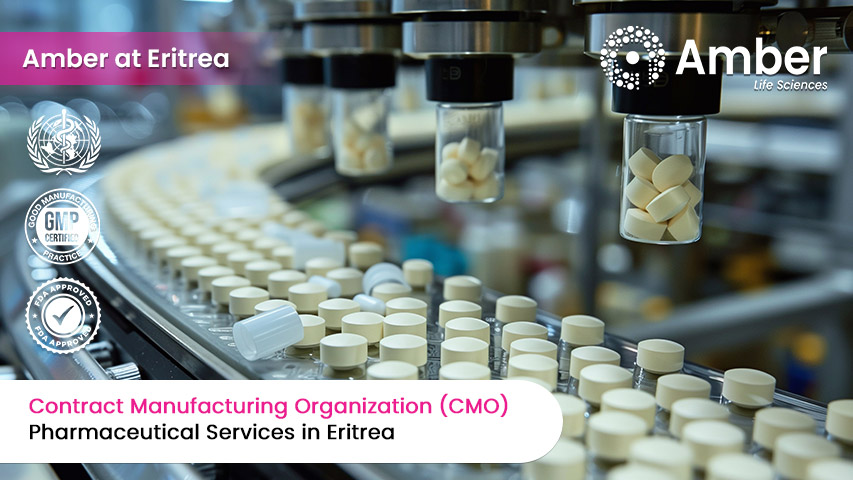
Eritrea’s pharmaceutical industry is highly limited, with no internationally recognized Contract Manufacturing Organizations (CMOs) in Eritrea operating in the country. Unlike emerging pharmaceutical hubs in East Africa, Eritrea depends almost entirely on imports for its medicine supply. Local capabilities are restricted to basic repackaging and small-scale production of simple formulations by the state-owned Hamas Pharmaceuticals and Medical Supplies Factory.
For international pharmaceutical companies, Eritrea is not a viable manufacturing destination. Instead, the country’s healthcare sector relies on global procurement, aid-based supply, and partnerships with manufacturers abroad. Amber Lifesciences, as a WHO-GMP and ISO-certified supplier based in India, supports such partnerships by providing high-quality APIs and pharmaceutical products for international distribution.
The Pharmaceutical Landscape in Eritrea
- Domestic Manufacturing Capabilities
- Key Player: Hamas Pharmaceuticals and Medical Supplies Factory (under ERIPHARM, Eritrean Pharmaceutical Association).
- Primary Functions:
- Limited production of intravenous fluids, antiseptics, and basic ointments.
- Repackaging bulk imports into smaller, distributable units.
- Limitations:
- No advanced facilities for APIs, sterile injectables, or biologics.
- Lacks international GMP certification and modern equipment.
- Why International CMOs Avoid Eritrea
Several barriers restrict international CMOs from investing in Eritrea:- Weak Regulatory Framework – No internationally recognized authority for GMP approval or inspections.
- Political & Economic Risks – Isolationist policies, restricted investment climate, and limited foreign partnerships.
- Infrastructure Gaps – Power shortages, poor logistics, and limited water supply hinder manufacturing.
- Small Market Size – With only 3.6 million people, the pharmaceutical demand does not justify large-scale investment.
- Intellectual Property Concerns – Weak IP protection discourages innovator pharma companies.
- How Eritrea Sources Medicines
- International Procurement – The Ministry of Health and ERIPHARM purchase medicines from India, China, the Middle East, and Europe.
- Donor & NGO Support – WHO, UNICEF, and aid programs play a significant role in supplying essential medicines.
- International Procurement – The Ministry of Health and ERIPHARM purchase medicines from India, China, the Middle East, and Europe.
Practical Alternatives for Pharma Companies
For companies aiming to serve Eritrea or nearby markets, these strategies are more practical:
- Contract Manufacturing in Neighboring Countries
- Ethiopia – Hosts Cadila Pharmaceuticals Ethiopia, Addis Pharmaceutical Factory, and other growing manufacturers moving toward GMP compliance.
- Sudan – Long-standing pharmaceutical industry, though facing operational challenges.
- Kenya – East Africa’s most advanced hub, home to multiple WHO-GMP certified plants offering end-to-end CMO services.
- Limited Collaboration with ERIPHARM
- Possible scope for secondary packaging or relabeling of products manufactured abroad.
- Process: Products manufactured and packaged internationally → bulk shipped to Eritrea → Hamas Pharmaceuticals conducts labeling and distribution in Spanish, Tigrinya, or Arabic if required.
- Challenges: Still limited by regulatory inefficiencies and infrastructure bottlenecks.
CMO Strategies and Key Considerations for Market Entry
- Compliance First – Always rely on GMP-certified CMOs outside Eritrea for quality assurance.
- Distribution Partnerships – Success in Eritrea requires a strong local partner with Ministry of Health connections.
- Logistics Planning – Be prepared for customs delays and supply chain difficulties.
- Aid-Focused Opportunities – Many suppliers serve Eritrea indirectly through NGO procurement channels.
CMO Services in Eritrea: Why Choose Amber Lifesciences Pvt. Ltd.
Even though Eritrea does not host international-standard pharmaceutical manufacturing facilities, global companies can still reach the Eritrean market through a reliable international partner. Amber Lifesciences Pvt. Ltd. offers exactly that.
Here’s why we are the trusted choice for CMO services supporting Eritrea:
- Global-Standard Compliance – Manufacturing facilities certified by WHO-GMP, USFDA, EU-GMP, and NAFDAC, ensuring quality products that meet international benchmarks.
- Customized Solutions – Expertise in formulation development, packaging, labeling, and supply-chain support tailored to the needs of the Eritrean healthcare sector.
- Regulatory Expertise – Complete support with dossier preparation, GMP documentation, and product registration, aligned with the Ministry of Health in Eritrea.
- Strong Export Network – Proven track record of supplying medicines across Africa, Asia, LATAM, and the Middle East, ensuring reliable delivery to Eritrea.
- End-to-End Partnership – From manufacturing to local distributor collaborations, Amber Lifesciences ensures smooth market entry and long-term sustainability.
By choosing Amber Lifesciences Pvt. Ltd., pharmaceutical companies gain a trusted global CMO partner capable of bridging the gap between international manufacturing excellence and Eritrea’s import-driven market.
Conclusion
Eritrea is not positioned for international-standard pharmaceutical contract manufacturing. Its pharmaceutical sector is underdeveloped, with only basic repackaging capacity at Hamas Pharmaceuticals.
For companies seeking to expand in East Africa, the real opportunities lie in Ethiopia, Kenya, or India, where internationally certified Contract Manufacturing Organizations provide reliable, GMP-compliant services. Eritrea will continue to remain an import-driven, aid-supported pharmaceutical market, where success depends on global partnerships and strong distribution networks rather than local manufacturing.
