











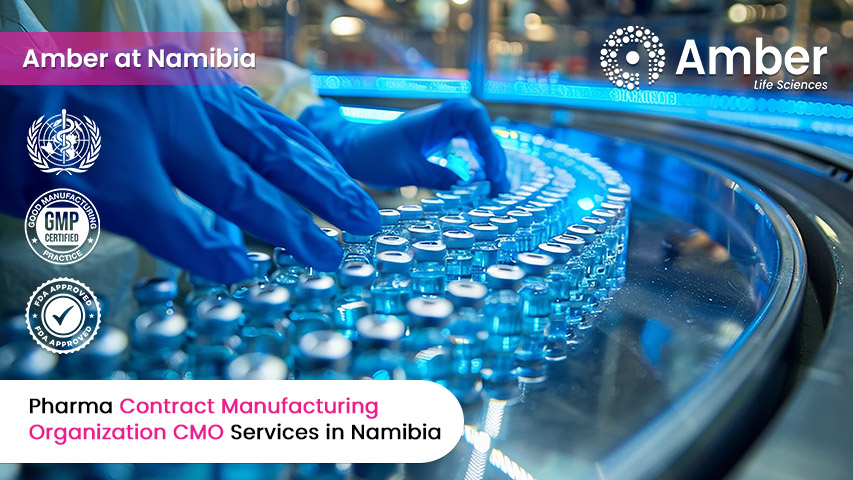
Namibia’s pharmaceutical Contract Manufacturing Organization (CMO) service market is still nascent and underdeveloped, with most medicines imported from South Africa, India, China, and Europe. Currently, over 90% of Namibia’s pharmaceutical demand is met through imports. Despite this limited domestic capacity, the government’s Harambee Prosperity Plan II and Vision 2030 have identified pharmaceutical manufacturing as a strategic growth area for job creation, medicine security, and regional exports.
This emerging landscape presents a compelling long-term opportunity for investors, CMOs, and pharmaceutical companies like Amber Lifesciences Pvt. Ltd., looking to establish a strong footprint in Southern Africa.
Current Pharmaceutical CMO Manufacturing Landscape in Namibia
- Limited Local Production: Only a few local players exist, primarily engaged in secondary packaging (blistering, labeling, and repackaging) or low-risk products such as IV fluids, antiseptics, and medical oxygen.
- Import Reliance: The bulk of tablets, capsules, injectables, and APIs is sourced from South Africa, India, China, and European manufacturers.
- Regulatory Authority: The Namibia Medicines Regulatory Council (NMRC) oversees drug registration, GMP compliance, and licensing, with strict adherence to WHO GMP standards.
Emerging “CMO-like” Services in Namibia
While Namibia does not yet have full-scale CMO capabilities, certain foundational services are available:
- Secondary Packaging & Labeling: Local repackaging of imported bulk medicines to meet regulatory and language (English) requirements.
- Medical Gases & Solutions: Local contract production of oxygen, saline solutions, and IV fluids.
- Quality Control Testing: Limited QC and assurance services for verifying imported medicines.
- Distribution & Cold Chain Logistics: Strong networks developed by importers for pharmaceutical distribution.
Contract Manufacturing Organization Key Local Players in Namibia
- Fabupharm (Pty) Ltd: One of the most prominent local manufacturers, engaged in limited packaging and basic product manufacturing.
- Durbatrix Pharmaceuticals: A major distributor showing interest in local manufacturing initiatives.
- Winthrop Pharmaceuticals Namibia: Focused primarily on marketing and sales, but part of a larger regional group.
Challenges Facing Pharmaceutical CMOs in Namibia
- High Capital Investment: Setting up WHO-GMP-compliant facilities requires heavy financial investment.
- Skilled Workforce Shortage: Limited availability of GMP-trained pharmacists, chemists, and engineers.
- Small Market Size: With a population of ~2.5 million, Namibia’s domestic demand is modest, making regional exports (SACU & SADC) essential.
- Dependence on Imported APIs: All APIs would need to be imported, adding complexity and cost.
- Regulatory Complexity: Licensing and site approval processes can be lengthy.
Contract Manufacturing Organization Future Outlook and Opportunities
Despite current limitations, Namibia has strategic potential for pharmaceutical CMOs:
- Government Incentives: Tax breaks, land in industrial parks, and infrastructure support.
- Regional Market Access: Membership in SACU (South Africa, Botswana, Lesotho, Eswatini) and SADC provides preferential trade opportunities.
- Public-Private Partnerships (PPPs): Potential for government-backed offtake agreements for essential medicines like ARVs, TB drugs, and vaccines.
- Technology Transfer: Partnerships with established CMOs can enable knowledge sharing and capacity building.
- Niche Manufacturing: Opportunities exist in herbal and natural products using indigenous plants such as Devil’s Claw, with regulatory approval.
How to Engage with CMOs in the Namibian Market
- Identify Local Partners: Approach existing players like Fabupharm for joint ventures.
- Government Engagement: Collaborate with the Ministry of Industrialisation & Trade and the Ministry of Health for incentives.
- Market Feasibility Studies: Assess cost structures, regulatory timelines, and SACU market demand.
- Regulatory Preparation: Engage early with the NMRC for GMP and licensing requirements.
Why Choose Amber Lifesciences for CMO Services in Namibia
- WHO-GMP, EU-GMP, and USFDA Compliance: Ensuring products meet the highest international quality and safety standards.
- Diverse Portfolio: Covering essential medicines for HIV/AIDS, malaria, TB, cardiovascular diseases, and more—aligned with Namibia’s healthcare priorities.
- Cost-Competitive Solutions: Delivering high-quality medicines at affordable prices for public tenders and NGOs.
- Strong African Market Experience: Proven track record in logistics, regulatory submissions, and large-scale supply to African nations.
- Reliable Partnerships: Trusted by governments, NGOs, and healthcare distributors worldwide.
By choosing Amber Lifesciences, Namibian stakeholders can access world-class pharmaceutical contract manufacturing services tailored to both local healthcare needs and regional market expansion.
Conclusion
Namibia may not yet have a mature pharmaceutical Contract Manufacturing Organization (CMO) service industry, but its government support, regional trade advantages, and emerging private sector players make it an attractive frontier for long-term investment. The path forward will require public-private collaboration, technology transfer, and export-driven strategies.
For international companies and local stakeholders, partnering with a globally trusted manufacturer like Amber Lifesciences provides a unique opportunity to build a sustainable pharmaceutical manufacturing ecosystem in Namibia and beyond.
