












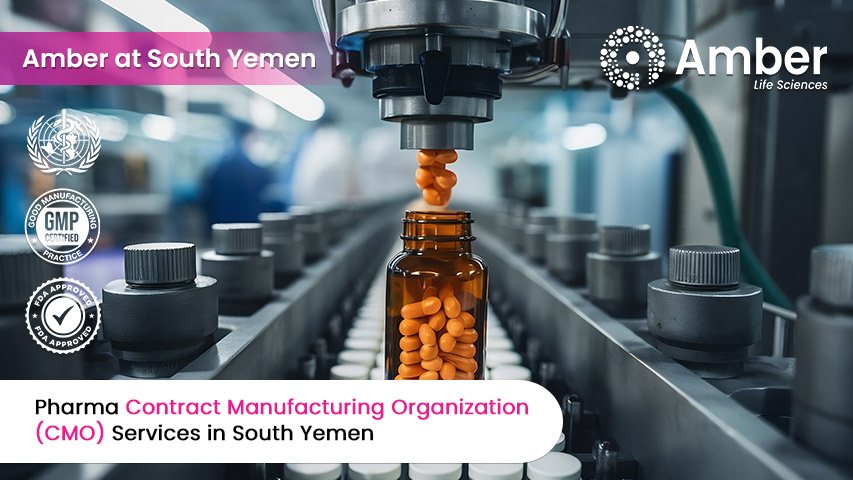
The pharmaceutical Contract Manufacturing Organization (CMO) services in South Yemen are extremely limited due to ongoing conflict, economic collapse, and political instability. Unlike other Middle Eastern countries with emerging manufacturing capacity, South Yemen has no internationally recognized GMP-certified CMOs operating within its borders. Amber Lifesciences, with its global expertise and WHO-GMP-compliant facilities, can provide reliable pharmaceutical CMO services to support healthcare needs in regions with limited local manufacturing capacity.
Instead, the country relies almost entirely on imported medicines from India, China, Jordan, Saudi Arabia, and the UAE—often through international aid agencies such as UNICEF and WHO, as well as private importers. What exists locally is small-scale repackaging and basic formulation, but these facilities lack strong regulatory oversight, consistency in quality, and capacity for export.
Challenges of Pharmaceutical CMOs in South Yemen
The environment for pharmaceutical services in South Yemen presents multiple barriers:
- Security & Instability: Ongoing conflict prevents long-term industrial investment and organized supply chain management.
- Destroyed Infrastructure: Poor road networks, damaged ports like Aden, and unreliable electricity supply cripple logistics.
- Economic Collapse: Severe currency devaluation and limited banking access hinder imports and international payments.
- Weak Regulation: Minimal enforcement of GMP standards by local authorities makes international exports impossible.
- Shortage of Skilled Workforce: Many pharmacists, chemists, and engineers have left the country, creating a technical skills gap.
- Supply Chain Disruption: Difficulty sourcing active pharmaceutical ingredients (APIs), excipients, and packaging materials due to import restrictions.
Existing “Manufacturing” and Packaging in South Yemen
While not CMOs in the global sense, some small players in Aden and other cities provide:
- Repackaging: Breaking down large imported medicine consignments into smaller pharmacy-ready packs.
- Simple Formulation: Basic generics like paracetamol, antibiotics, and antacids are produced using imported powders.
- Licensed Local Production: Limited packaging agreements with Middle Eastern or Asian companies for local sales.
Quality, safety, and consistency vary widely across these operations, posing a challenge for public health.
Practical Strategies for Engaging in South Yemen’s Pharmaceutical Market
Since full-service CMOs do not exist locally, international companies must adopt alternative approaches:
Partner with International CMOs Outside Yemen
- Work with CMOs in Jordan, Saudi Arabia, or Egypt that have robust GMP standards.
- Manufacture finished products abroad.
- Import and distribute through Yemeni networks.
Collaborate with Local Importers for Distribution
- Identify experienced importers in Aden who understand customs, logistics, and regulatory approvals.
- Source medicines from reliable international manufacturers (India, China, Europe).
- Let local partners handle in-country warehousing and hospital/pharmacy distribution.
Explore Local Packaging Partners (High Risk)
- Audit local facilities thoroughly for compliance and capacity.
- Request documentation such as licenses and product registrations.
- Conduct independent lab testing of finished products.
- Begin with low-risk, small-scale contracts before expanding.
CMO Regulatory Authority in South Yemen
All pharmaceutical products marketed in South Yemen’s internationally recognized government areas must be registered with the Ministry of Public Health and Population (Aden office). This step is essential, even for imported finished products.
Why Choose Amber Lifesciences as Your CMO Partner for Yemen
Amber Lifesciences Pvt. Ltd. offers the global expertise and reliability that South Yemen’s market currently lacks:
- International Quality Certifications: WHO-GMP, EU-GMP, USFDA-compliant facilities.
- Global Manufacturing Network: Large-scale production across APIs, formulations, sterile injectables, and specialty drugs.
- Regulatory Strength: Experience in registering products across the Middle East, Africa, LATAM, and Europe, ensuring smoother approvals.
- Secure Supply Chain: Ability to manufacture abroad and distribute safely into South Yemen via trusted logistics partners.
- Custom Services: Tailored solutions ranging from bulk drug supply to finished formulations, sterile fill-finish, packaging, and stability testing.
- Commitment to Humanitarian Markets: Support for aid agencies and NGOs working in fragile healthcare environments.
By choosing Amber Lifesciences, pharmaceutical distributors, aid agencies, and government buyers can overcome South Yemen’s challenges and ensure patients have access to safe, affordable, and reliable medicines.
Conclusion
The concept of a full-fledged, GMP-compliant Contract Manufacturing Organization in South Yemen remains aspirational. For now, the pharmaceutical sector depends heavily on imports and aid supplies, with only limited local repackaging and formulation.
The most effective strategy is to:
- Manufacture with a reliable CMO in a stable neighboring country.
- Partner with experienced Yemeni distributors for in-country logistics.
With its international certifications, proven expertise, and global presence, Amber Lifesciences Pvt. Ltd. is ideally positioned to bridge this gap—delivering high-quality medicines to South Yemen while supporting healthcare resilience in one of the region’s most challenging environments.
