








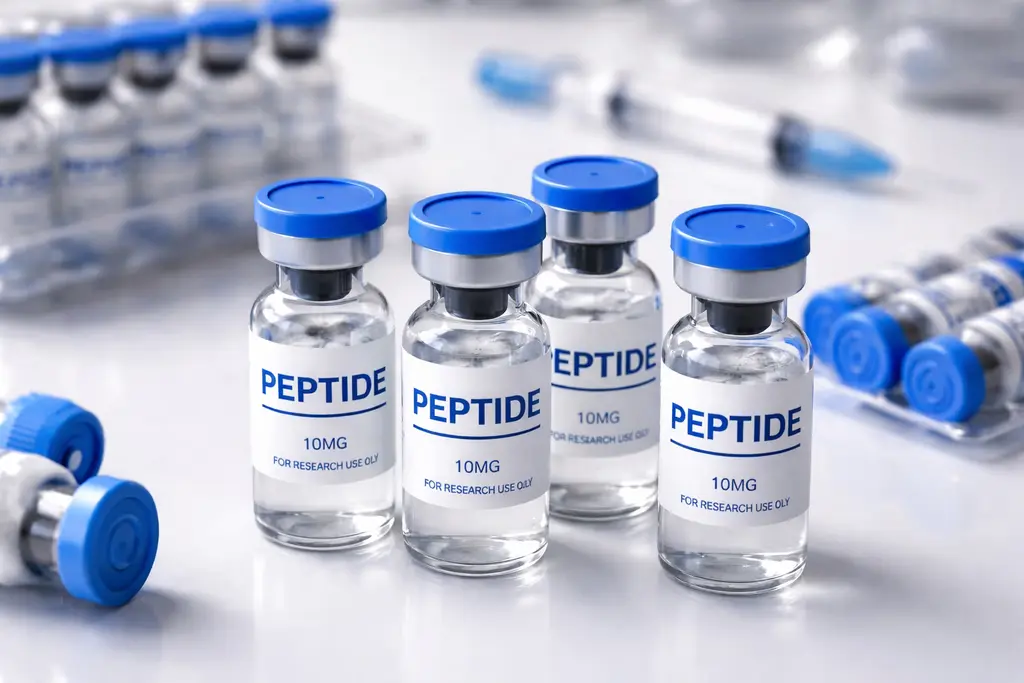
Peptides have moved from the pages of biochemistry textbooks to the front of modern medicine. They regulate blood sugar, control appetite, fight infection, and heal wounds — and they now sit behind some of the fastest-growing drug classes in the world. Yet for most people the basic question remains unanswered: what actually is a peptide?
This guide answers that from the ground up. No prior chemistry needed.
What Are Peptides?
A peptide is a short chain of amino acids linked together by chemical bonds called peptide bonds. Think of amino acids as beads and a peptide as a short string of those beads — typically between two and fifty amino acids long.
That chain is not random. The exact order of amino acids, called the sequence, determines what the peptide does in the body. Change one amino acid and the peptide may lose its function entirely, or gain a new one.
Peptides occur naturally in every living organism. In humans they act mainly as signalling molecules — chemical messengers that bind to receptors on the surface of cells and instruct them to do something: release a hormone, reduce inflammation, trigger hunger, or begin repair. Insulin, which regulates blood glucose, is among the best known.
Peptides and Amino Acids: The Building Blocks
To understand peptides, start one level down.
Amino acids are small organic molecules built around a central carbon atom carrying four groups: an amino group, a carboxylic acid group, a hydrogen atom, and a variable side chain known as the R group. That side chain is what makes each amino acid distinct — some are water-loving, some water-repelling, some carry an electrical charge.
There are 20 standard amino acids used by the human body to build peptides and proteins. Nine of them are essential, meaning the body cannot make them and must obtain them from food.
When two amino acids join, the acid group of one reacts with the amino group of the other, releasing a molecule of water and forming a peptide bond. Repeat that reaction and the chain grows. Peptides are classified by how many amino acids they contain:
| Term | Length |
| Dipeptide | 2 amino acids |
| Tripeptide | 3 amino acids |
| Oligopeptide | Roughly 2–20 amino acids |
| Polypeptide | 20+ amino acids |
| Protein | Generally 50–100+ amino acids |
Every peptide chain has two ends: the N-terminus (free amino group) and the C-terminus (free acid group). By convention, peptide sequences are always written from N-terminus to C-terminus — which is also the direction the body builds them.
Peptides vs Proteins: What’s the Difference?
This is the most common beginner question, and the answer is mostly about size and complexity.
| Peptides | Proteins | |
| Length | Typically 2–50 amino acids | Hundreds to thousands |
| Structure | Simple, limited folding | Complex, folded 3D domains |
| Main role | Signalling, hormone action | Enzymes, structure, immunity, transport |
| Manufacture | Usually chemical synthesis | Usually recombinant (cell-based) |
| Stability | Shorter half-life in the body | Generally more stable |
The dividing line is a convention, not a law of nature. Most scientists place the cut-off somewhere between 50 and 100 amino acids, and some molecules sit awkwardly in between. Insulin, at 51 amino acids, is described as both a peptide and a small protein depending on who is writing.
The practical difference matters most in manufacturing. Peptides are short enough to be built chemically, one amino acid at a time, with complete control over the sequence. Proteins are generally too long for that and must be produced biologically, by engineering living cells to express them.
How Are Peptides Made — Naturally and Chemically?
Naturally, inside living cells
The body makes most of its peptides through ribosomal synthesis. DNA is transcribed into messenger RNA, and ribosomes read that message three letters at a time, adding the corresponding amino acid to a growing chain. Many peptide hormones are first made as larger inactive precursors, then cut by enzymes into their final active form — insulin, for example, begins life as proinsulin.
A second natural route, non-ribosomal peptide synthesis, is used mainly by bacteria and fungi. Large enzyme complexes assemble peptides without a genetic template, which is how nature produces unusual structures such as the antibiotic vancomycin.
Chemically, in the laboratory
Chemical synthesis lets scientists build any peptide sequence they choose, including ones that do not exist in nature — with unnatural amino acids, cyclic structures, or attached chemical groups that improve stability. This is the foundation of custom peptide synthesis and of the peptide pharmaceutical industry.
There are three main approaches:
Solid phase peptide synthesis (SPPS) — invented by Bruce Merrifield in 1963, work that won him the Nobel Prize. The peptide is assembled while anchored to a solid resin bead, which means excess reagents and by-products can simply be washed away after every step. SPPS is the workhorse for most peptides of roughly 5 to 60 amino acids.
Liquid phase peptide synthesis (LPPS), also called solution phase synthesis — the older method, carried out entirely in solution. It requires isolation and purification after each step, which is more laborious, but it scales extremely well and is often the economical choice for short peptides produced in large volumes.
Hybrid synthesis — the two combined. Fragments are built by SPPS, then joined in solution by segment condensation or chemical ligation. This is how long or structurally difficult peptides are produced at commercial scale.
What Is the Peptide Synthesis Process?
The SPPS cycle is repetitive by design. Each amino acid is added through the same four-step loop:
- Resin loading — the first amino acid, with its reactive groups chemically protected, is attached to the solid support.
- Deprotection — the temporary protecting group on the N-terminus is removed, exposing a reactive site. In modern Fmoc chemistry this is done with a mild base.
- Coupling — the next protected amino acid is activated and joined to the exposed end, forming a new peptide bond.
- Washing — solvents flush away unreacted reagents, leaving only the growing chain on the resin.
Steps 2 to 4 repeat once for every amino acid in the sequence. A 30-amino-acid peptide means around 30 cycles — and because each cycle is slightly less than perfectly efficient, longer sequences become progressively harder to make cleanly.
Once assembly is finished, three stages complete the process:
- Cleavage — a strong acid, usually trifluoroacetic acid, releases the peptide from the resin and strips the remaining side-chain protecting groups.
- Purification — preparative reverse-phase HPLC separates the target peptide from closely related impurities such as deletion and truncation sequences. This is the most demanding and often the most expensive stage of the whole process.
- Analysis and isolation — identity and purity are confirmed by mass spectrometry and analytical HPLC, after which the peptide is typically lyophilised (freeze-dried) into a stable powder.
Types of Peptides
Peptides are grouped in several overlapping ways.
By structure
- Linear peptides — a simple straight chain
- Cyclic peptides — the chain closes into a ring, dramatically improving stability
- Disulfide-bridged peptides — cysteine residues bond to lock the molecule into a defined shape
- PEGylated and lipidated peptides — chemically modified to extend half-life in the body
- Peptide conjugates — attached to a drug, dye, or oligonucleotide to deliver a payload
By biological function
- Hormone peptides — insulin, glucagon, oxytocin, GLP-1
- Antimicrobial peptides — part of the innate immune defence
- Neuropeptides — signal within the nervous system, including endorphins
- Growth factor peptides — regulate cell growth and tissue repair
- Bioactive food peptides — released during digestion of dietary protein
Where Are Peptides Used?
Medicine. More than 80 peptide drugs have been approved worldwide since insulin was first isolated in 1921, with over 170 more in active clinical development. They treat type 2 diabetes and obesity, several cancers, cardiovascular and urological conditions, osteoporosis, and chronic pain. The GLP-1 receptor agonists used in diabetes and weight management are the most commercially significant peptide class today.
Diagnostics. Peptides serve as highly specific binding agents in immunoassays and imaging, and as reference standards in analytical testing.
Antibody production. Synthetic peptide fragments are used as antigens to raise antibodies against a precisely chosen region of a target protein — a routine tool in research and biotech.
Research. Custom peptides let scientists probe how proteins interact, map enzyme activity, and validate drug targets.
Cosmetics. Short peptides such as signal and carrier peptides appear widely in skincare, marketed for their role in collagen support. Evidence quality here varies considerably by product.
Nutrition. Collagen and whey peptides are sold as supplements, valued mainly for their high digestibility.
What Is Peptide Therapy, and Is It Safe?
“Peptide therapy” is an umbrella term covering two very different things, and conflating them causes real harm.
Approved peptide medicines are prescription drugs that have passed full clinical trials and regulatory review — insulin, semaglutide, leuprolide, octreotide, teriparatide and dozens of others. Their benefits, risks, dosing, and side effects are documented, and they are manufactured to strict cGMP pharmaceutical standards. Used as prescribed, their safety profile is well characterised.
Unregulated peptides are a different matter. Many compounds sold online for muscle growth, anti-ageing, tanning or recovery have never been approved for human use. They are frequently labelled “research use only,” are not manufactured to pharmaceutical standards, and may vary in purity, identity, and sterility. Studies of grey-market peptide products have repeatedly found mislabelled contents and contamination. Regulators including the FDA have restricted a number of these compounds.
As a drug class, peptides have genuine advantages: high specificity for their target, low toxicity, and lower immunogenicity than large biologic drugs. They also have well-known limitations — most are broken down quickly by digestive enzymes, which is why the majority are injected rather than swallowed, and they generally cannot cross cell membranes, so about 90% of peptides in clinical development act on targets outside the cell.
The practical rule: a peptide is safe in the same way any drug is safe — when it has been approved for a specific use, manufactured to pharmaceutical standards, and prescribed by a qualified clinician who knows your medical history. Anything bought outside that chain carries risks that no marketing claim can offset. Speak to a healthcare professional before starting any peptide treatment.
Frequently Asked Questions About Peptides
1. What is the difference between a peptide and a protein?
Length and complexity. Peptides are short chains of roughly 2 to 50 amino acids with limited folding, while proteins contain 50–100 or more amino acids folded into complex three-dimensional shapes. The boundary is a scientific convention rather than a hard rule, and molecules near the cut-off — such as insulin at 51 amino acids — are described either way.
2. Are peptides the same as amino acids?
No. Amino acids are the individual building blocks; a peptide is a chain of them joined by peptide bonds. A single amino acid is not a peptide — you need at least two.
3. How are peptides manufactured?
Naturally, cells build peptides on ribosomes using instructions from DNA. Commercially, peptides are made by chemical synthesis — solid phase peptide synthesis (SPPS), liquid phase peptide synthesis (LPPS), or a hybrid of the two — adding one protected amino acid at a time, then cleaving, purifying by HPLC, and freeze-drying the final product.
4. What are peptides used for?
Approved peptide drugs treat diabetes, obesity, cancer, osteoporosis, hormonal disorders and chronic pain. Beyond medicine, peptides are used in diagnostics, antibody production, laboratory research, cosmetic formulations and nutritional supplements.
5. Are peptides safe to take?
Approved, prescribed peptide medicines have established safety profiles and are manufactured to cGMP standards. Peptides sold online without approval are a different category — they are not made to pharmaceutical standards, may be impure or mislabelled, and have not been tested for human safety. Always consult a healthcare professional before use.
Peptides at Commercial Scale — With Amber
Turning a peptide sequence into an approved medicine takes far more than a good idea. It takes synthesis routes that scale, purification capacity that holds purity at kilogram volumes, and analytical and regulatory work that stands up to inspection.
Amber LifeSciences provides custom peptide synthesis from milligram research quantities to multi-kilogram cGMP supply, combining SPPS, LPPS, and hybrid synthesis with in-house purification, analytical development, and regulatory support.
Talk to our peptide team about your programme.
References
- Institute for Molecular Bioscience, University of Queensland — Explainer: peptides vs proteins — what’s the difference? https://imb.uq.edu.au/article/2017/11/explainer-peptides-vs-proteins-whats-difference
- Bachem Knowledge Center — Peptides vs Proteins: What’s the Difference? https://www.bachem.com/knowledge-center/peptides-vs-proteins-whats-the-difference/
- Bachem Knowledge Center — Peptides and Amino Acids for Beginners. https://www.bachem.com/knowledge-center/peptide-guide/peptides-and-amino-acids-for-beginners/
- Wang L. et al. — Therapeutic peptides: current applications and future directions. Signal Transduction and Targeted Therapy (Nature). https://www.nature.com/articles/s41392-022-00904-4
- Britannica — What is the difference between a peptide and a protein? https://www.britannica.com/story/what-is-the-difference-between-a-peptide-and-a-protein
- Neuland Laboratories — Peptide Services / CDMO Peptides. https://www.neulandlabs.com/en/cdmo-services/peptides
- PharmaSource — Peptide Therapeutics Manufacturing: A Comprehensive Guide. https://pharmasource.global/content/guides/category-guide/peptide-therapeutics-manufacturing-a-comprehensive-guide/
